
How Sellers Can Prepare for Amazon Prime Day 2026
Every year, a single four-day window in late June moves more online purchases than most e-commerce brands see in an entire quarter. Amazon Prime Day 2026 will be no different, and for sellers who rely on Amazon as a sales channel or who simply benefit from the traffic spike it creates across the wider web, April is when smart preparation begins. The sellers who treat Prime Day like an ordinary sales week almost always lose to the ones who start planning twelve weeks out.
This guide walks through what to expect from Prime Day 2026, the data behind why it matters, and the operational steps US-based e-commerce sellers should take now to protect margins, avoid stockouts and capture the halo traffic that lifts the entire online retail economy during event week.
Key Takeaways for Amazon Prime Day 2026
- Amazon Prime Day 2026 is confirmed by Amazon to run June 23 to 26, 2026, a four-day event and the first June Prime Day since 2021, with a second shorter event (Prime Big Deal Days) returning in October (Huboo, 2026).
- US online spending during the four-day Prime Day 2025 event reached $24.1 billion, a 30.3% year-over-year jump (Adobe Analytics via Digital Commerce 360, 2025).
- Even brands that did not run official Prime Day deals saw a roughly 46% sales lift during event week, thanks to elevated buyer intent across the internet (Acadia via Kensium, 2025).
- Inventory planning is the single biggest operational risk, especially for FBA sellers navigating tighter restock limits that tend to appear in May and June.
- Sellers who launch campaigns 7 to 10 days before the event consistently outperform those who wait until Prime Day opens (ChannelEngine, 2025).
When Is Amazon Prime Day 2026?
Amazon has officially confirmed that Amazon Prime Day 2026 will run from June 23 to 26, a four-day event beginning at 12:01 a.m. PDT on Tuesday, June 23. This is a significant break from tradition. Prime Day has been a July event for most of its history, and 2026 marks the first June Prime Day since 2021. For sellers, the earlier date compressed every preparation deadline by several weeks compared to past years.
The stakes are higher than ever. Emarketer projects that Amazon’s US sales will rise 7.1% during the four-day event, outpacing the 6.0% growth expected for non-Amazon online sales during the same period. As a result, Amazon’s share of total US e-commerce sales during Prime Day 2026 is forecast to reach 60.3%, the highest level since 2019 (Retail Dive, 2026).
Amazon Prime Day 2026 Seller Preparation Timeline
| Timeframe | Seller Action |
|---|---|
| Now (early to mid June 2026) | FBA inbound cutoff has likely passed; pivot to FBM, Seller Fulfilled Prime or 3PL fulfillment for any restocks |
| June 13 to 22, 2026 | Finalize deal pricing, refresh listings, warm up PPC campaigns, activate email and SMS to existing customers |
| 7 to 10 Days Before Event | Confirm inventory levels with your fulfillment partner, set daily ad budget pacing, prepare customer service for volume |
| June 23 to 26, 2026 | Prime Day event window: monitor inventory velocity, pace ad spend daily, watch for stockout risk on fast movers |
| Late June to July 2026 | Post-event returns processing, reorder fast-movers, carry momentum into summer and begin early Q4 planning |
Sellers should also prepare for the fall event. Amazon has run Prime Big Deal Days every October since 2022, and the 2026 fall edition is widely expected to return around early to mid-October. Planning for both events in the same calendar, rather than treating Prime Day as a one-off moment, is how the most organized sellers spread risk and avoid the inventory whiplash that follows a single concentrated push.
Why the earlier date changes everything
The move from July to late June pulled every preparation deadline forward. FBA inbound cutoffs that sellers expected in June landed in late May and early June instead. If your inventory is not already at Amazon’s fulfillment centers, the window for FBA has effectively closed for this event. The practical response now is to lean on FBM, Seller Fulfilled Prime or a 3PL partner that can ship orders directly during the event. Sellers who pre-positioned inventory in a US fulfillment network have the flexibility to capture Prime Day demand even without relying on FBA.

Why Prime Day Matters More Than the Sales Volume Alone
The headline numbers from Prime Day 2025 are genuinely impressive. US consumers spent $24.1 billion online across the four-day event, which represented a 30.3% jump over 2024 and more online spending than any other single day of 2025 on day one alone (Adobe Analytics via Digital Commerce 360, 2025). But the more useful figure for sellers is the one that does not make headlines: the halo.
Analytics firm Acadia found that brands that did not run an official Prime Day promotion still saw a sales lift of approximately 46% during event week, driven by the general surge in buyer intent across the internet (Acadia via Kensium, 2025). For Shopify, BigCommerce, and direct-to-consumer brands running their own stores, this is the real opportunity. Shoppers in buying mode do not restrict themselves to a single marketplace, and sellers who coordinate their own promotions with Prime Day benefit from paid search tailwinds, referral traffic, and a buying psychology that most other weeks of the year cannot match.
A Tinuiti survey also found that nearly 1 in 5 Prime members actively wait for Prime Day to make a purchase they have been planning, which means demand during the event is unusually concentrated and ready to convert.
What tends to sell
Prime Day 2025 data from Numerator and Adobe showed the following patterns worth noting:
- Two-thirds of items sold for under $20, with an average spend per item of $24.59.
- Top-performing categories were apparel and shoes, household essentials and home goods.
- The hottest specific products were consumable everyday items, including Premier Protein Shakes, Dawn Platinum Powerwash and Liquid IV packets.
- 53.2% of purchases came from mobile devices, which reinforces the importance of mobile-optimized listings and checkout flows.
The takeaway is that Prime Day shoppers skew toward replenishment and practical purchases at accessible price points, not only big-ticket electronics. Sellers in consumables, household and everyday essentials often see the strongest event-to-baseline lift.

Inventory Planning Is the Single Biggest Risk
Stockouts during Prime Day do more damage than lost orders. They hurt sales rank, break advertising momentum and often take weeks to recover from. Most experienced sellers plan for roughly 3x their normal daily sales velocity across the event window, then add safety stock on top.
On the FulfillmentByAmazon feed on Reddit, sellers have been discussing the ongoing tightness of FBA restock limits for several seasons now, with many reporting sudden overnight reductions of 20 to 50% and a community petition that gathered over 1,300 signatures pushing back on Amazon’s storage decisions. It is a recurring concern that shapes how experienced sellers plan inventory, especially in the weeks leading up to a major event.
A practical inventory calculation
A simple framework most sellers use for Prime Day planning:
- Start with your average daily units sold over the last 60 days.
- Multiply by a category multiplier (1.5x for slow categories, 3x for fast-moving, up to 5x for deal-heavy electronics and beauty).
- Multiply by the number of event days (4 is the safer assumption).
- Add 50% safety stock on top of that total.
Whatever the result, build in overflow capacity outside FBA. A growing number of sellers now hold overflow inventory with a third-party 3PL warehousing partner rather than relying on FBA alone, which gives them the flexibility to ship into Amazon in batches as restock limits allow rather than trying to push everything in at once.
FBA, FBM and SFP: Which Fulfillment Model Wins on Prime Day?
The Buy Box drives over 80% of Amazon sales (Flowspace, 2025), and the Prime badge remains the single biggest signal for winning the Buy Box. That is why most high-volume sellers default to FBA for Prime Day. But FBA is not the only option, and for sellers who have been burned by restock limits or who want a more resilient operation, layering FBM and Seller Fulfilled Prime into the mix is now standard practice.
FBA vs FBM vs Seller Fulfilled Prime
| Fulfillment Model | Best For |
|---|---|
| FBA (Fulfillment by Amazon) | High-volume sellers who want Prime badge and Buy Box priority, and can absorb storage fees and restock limits |
| FBM (Fulfilled by Merchant) | Sellers with their own warehouse or 3PL who want to avoid FBA fees, used often as a backup when FBA stock runs low |
| Seller Fulfilled Prime (SFP) | Established sellers with strong fulfillment performance who want Prime badge without relying on FBA warehouses |
| Hybrid (FBA plus 3PL Overflow) | Sellers preparing for Prime Day who need primary FBA inventory plus external storage to replenish during the event window |
A quick comparison:
- FBA (Fulfillment by Amazon): Best for Prime badge, Buy Box and speed. Downsides are restock limits, storage fees and dependence on Amazon’s capacity decisions.
- FBM (Fulfilled by Merchant): The seller handles storage, picking, packing and shipping. Works well as a backup channel, but FBM listings typically do not receive the Prime badge unless enrolled in SFP.
- Seller Fulfilled Prime (SFP): Allows Prime-badge eligibility from the seller’s own warehouse or 3PL, but requires meeting strict performance criteria, including same-day and two-day delivery standards.
Sellers who run a hybrid approach, with primary inventory in FBA and overflow held at a US 3PL that can ship FBM or SFP orders during high-velocity windows, tend to be the most resilient. This kind of contingency setup protects against both restock limit surprises and demand spikes during the event itself.
FBA inventory deadlines
With Prime Day 2026 confirmed for June 23 to 26, the FBA inventory window has effectively closed. Amazon typically requires inventory to arrive at fulfillment centers three to four weeks before the event, which placed delivery appointment deadlines in late May, with inventory ideally in transit by early May. Sellers who did not get stock into FBA in time are not out of the event. FBM, Seller Fulfilled Prime and 3PL fulfillment all allow you to ship Prime Day orders directly, and sellers who pre-positioned inventory in a US fulfillment network retain full flexibility to capture demand during the four-day window.

Listings and Advertising: The 10-Day Pre-Event Window
ChannelEngine’s 2025 Prime Day recap identified a consistent pattern among top-performing brands: they started advertising and listing updates 7 to 10 days before the event rather than waiting for Prime Day itself (ChannelEngine, 2025). The reasoning is simple. Amazon’s algorithm rewards listings that are already generating traffic, clicks, and conversions when the event opens, which means the sellers who warm up their campaigns in advance enter the event with momentum.
Priorities for the 10 days before Prime Day:
- Refresh main images, A+ content and bullet points based on your highest-converting copy.
- Expand your keyword set with seasonal and Prime Day-related terms, placed naturally in titles and bullets rather than stuffed.
- Pre-stage your deal pricing and coupons so you can activate on Day 1 without last-minute errors.
- Increase PPC bids gradually in the 5 to 7 days before the event to establish rank.
- Plan email and SMS campaigns to existing customers so they check your Amazon listing first.
A note on pacing during the event
Momentum Commerce, which manages sales for 50 brands on Amazon, reported that day one of Prime Day 2025 saw a 41% drop in opening sales compared to day one of the 2024 two-day event (AInvest via Momentum Commerce, 2025). The extended four-day format diluted the urgency that made the older two-day events so intense. Sellers should structure their ad budgets and deal cadence for a marathon, not a sprint. Pacing daily spend across the four days, rather than front-loading everything into day one, is now a proven tactic.
Post-Prime Day: Returns, Reorders and Q4 Momentum
Prime Day does not end when the event closes. Returns typically spike in the two to three weeks after the event, and sellers who run out of stock during Prime Day often face a recovery period where sales rank needs to be rebuilt. Both are fixable, but only with a plan.
Useful moves in the weeks after Prime Day:
- Review returns data to flag quality or listing-description issues before Q4.
- Reorder fast-moving SKUs within 72 hours of the event closing. October Prime Big Deal Days and Black Friday follow fast, and the peak season preparation window is shorter than most sellers expect.
- Audit your fulfillment partners and carrier performance, especially given the current pressure on shipping costs across e-commerce this year.
- Use the post-event lull in July to negotiate better carrier rates, review 3PL contracts, and prepare for peak season.
What Sellers Learn the Hard Way
A few common mistakes that come up every Prime Day cycle, drawn from seller community discussions and practical experience supporting e-commerce brands through event weeks:
- Assuming FBA will have space when you need it. Restock limits tighten in May and June almost every year.
- Setting deal prices that leave no margin. Prime Day moves units, but margin discipline protects the rest of the year.
- Ignoring the October event. Sellers who reorder fast after June capture the fall halo as well.
- Running out of packaging or labels. Small supply chain gaps cause big problems during event weeks.
- Not coordinating inventory across Amazon and direct-to-consumer channels. Overselling on Shopify because FBA depleted your DTC backup is a painful way to discover your inventory system has gaps.
What Our Clients Say
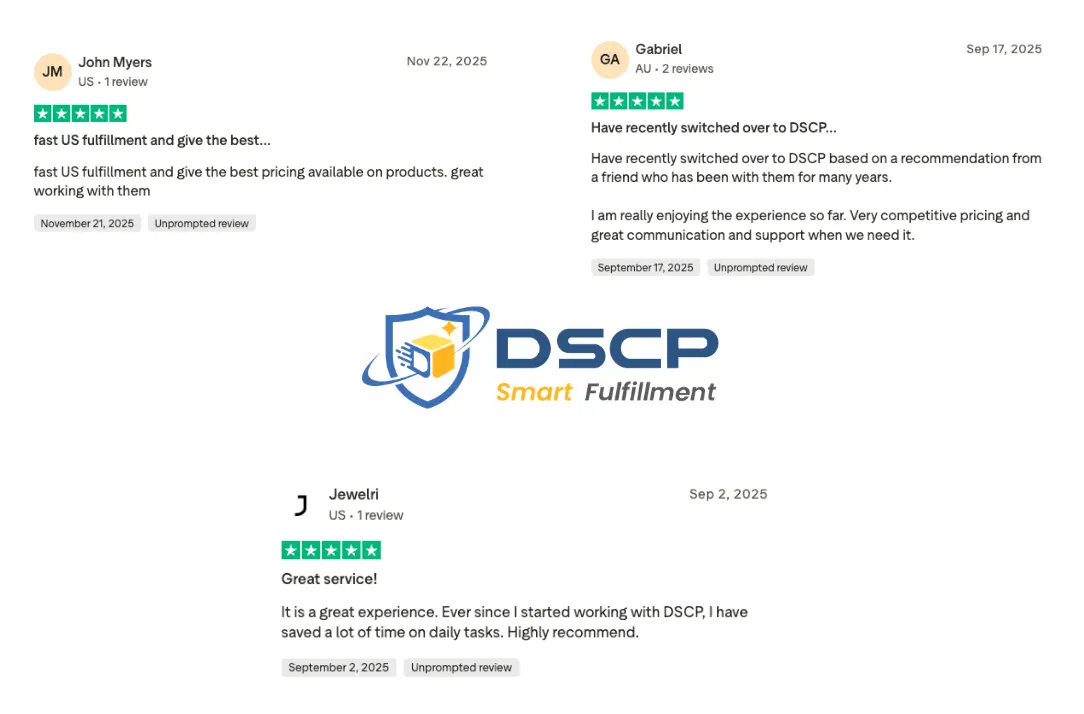
Prime Day is a stress test for any fulfillment operation, which is why e-commerce sellers tend to value reliability, competitive pricing and responsive support when choosing a US 3PL partner. A few consistent themes come up in our client feedback on Trustpilot.
John Myers, a US-based seller, points to the speed of our US fulfillment operation and competitive pricing as the core reasons he continues to work with DSCP Smart Fulfillment, describing the day-to-day partnership as a positive one.
Gabriel recently moved his operation over to DSCP Smart Fulfillment on a recommendation from a long-term client. His early experience has been shaped by competitive pricing alongside the kind of communication and support that make daily fulfillment decisions easier to handle.
Jewelri store owner highlights time savings as the biggest shift since partnering with DSCP Smart Fulfillment, noting that hours previously lost to daily fulfillment tasks are now free for other parts of the business, which matters even more during high-velocity windows like Prime Day.
Ready for Prime Day 2026?
The sellers who win Prime Day are the ones who plan in April. If you need overflow storage, FBA prep, or a reliable e-commerce fulfillment partner to handle the volume spike, get in touch with DSCP Smart Fulfillment and we will help you build a plan that holds up through June and into Q4.

AI Tools That Help E-Commerce Sellers Grow in 2026
Eight AI tools that deliver measurable results for e-commerce sellers in 2026, covering customer support, marketing, content, pricing and forecasting.

7 Ways to Reduce E-Commerce Shipping Costs
Seven practical ways to cut shipping costs for your online store, from right-sizing packaging to positioning inventory closer to your customers.