
B2B vs DTC Fulfillment: What Every Seller Should Know
Your store is running, orders are flowing and then it happens: a retailer emails asking to stock your product, or a distributor wants to place a bulk order. Suddenly, you are facing a completely different kind of fulfillment, one your direct-to-consumer setup was never built to handle. The pick-and-pack process that ships single units to individual shoppers does not translate cleanly to palletized orders bound for a retailer’s distribution center.
This is the moment many growing brands discover that B2B and DTC fulfillment are fundamentally different operational models. Both involve storing inventory and shipping orders, but almost everything else, from order size to packaging to compliance to delivery expectations, diverges sharply. Getting the difference wrong leads to delays, chargebacks and margin erosion. Getting it right lets you scale into new channels without breaking what already works.
The stakes are rising because more brands are running both models at once. According to NuOrder’s 2026 State of B2B eCommerce Report, 78% of senior leaders now rank wholesale as their number one investment channel, even as many of them continue to operate DTC storefronts (NuOrder, 2026). This guide breaks down how the two fulfillment models differ, when each applies, and how to support both without doubling your operational overhead.

Key Takeaways
- DTC fulfillment ships high volumes of small, single-unit orders directly to individual consumers. B2B fulfillment ships larger bulk orders to retailers, wholesalers and distributors.
- The two models differ across order size, packaging, shipping method, compliance requirements, delivery expectations and cost structure.
- B2B often involves pallets, case packs, EDI compliance and retailer routing rules that DTC operations never encounter.
- More brands are running both models at once, and doing so well requires a unified inventory system rather than two disconnected operations.
- The right fulfillment partner can support both channels from a single inventory pool, which prevents the errors and inventory conflicts that break improvised hybrid setups.
What Is DTC Fulfillment?
Direct-to-consumer (DTC) fulfillment is the process of shipping individual orders straight to the end customer. When someone buys from your online store, a warehouse picks the item, packs it in branded packaging and ships it to their door, then handles any returns. This is the model most e-commerce brands start with, and it is built around high volumes of small, single-unit orders.

The DTC market is large and growing fast. US direct-to-consumer e-commerce reached $239.75 billion in 2025, accounting for 19.2% of total retail e-commerce (Swell, 2026). The defining traits of DTC fulfillment are speed, branding and the customer experience. Consumers expect fast delivery, real-time tracking and a polished unboxing because the delivery experience is part of the brand. This is why pick and pack accuracy and delivery speed matter so much in DTC: every order is a direct touchpoint with a customer who will judge your brand by it.
What Is B2B Fulfillment?
Business-to-business (B2B) fulfillment is the process of shipping larger, bulk orders to other businesses: retailers who will stock your product on their shelves, wholesalers who resell it, or distributors who move it through their networks. Instead of thousands of single-unit shipments, B2B typically means fewer orders of much larger size, often shipped on pallets via freight rather than parcel carriers.
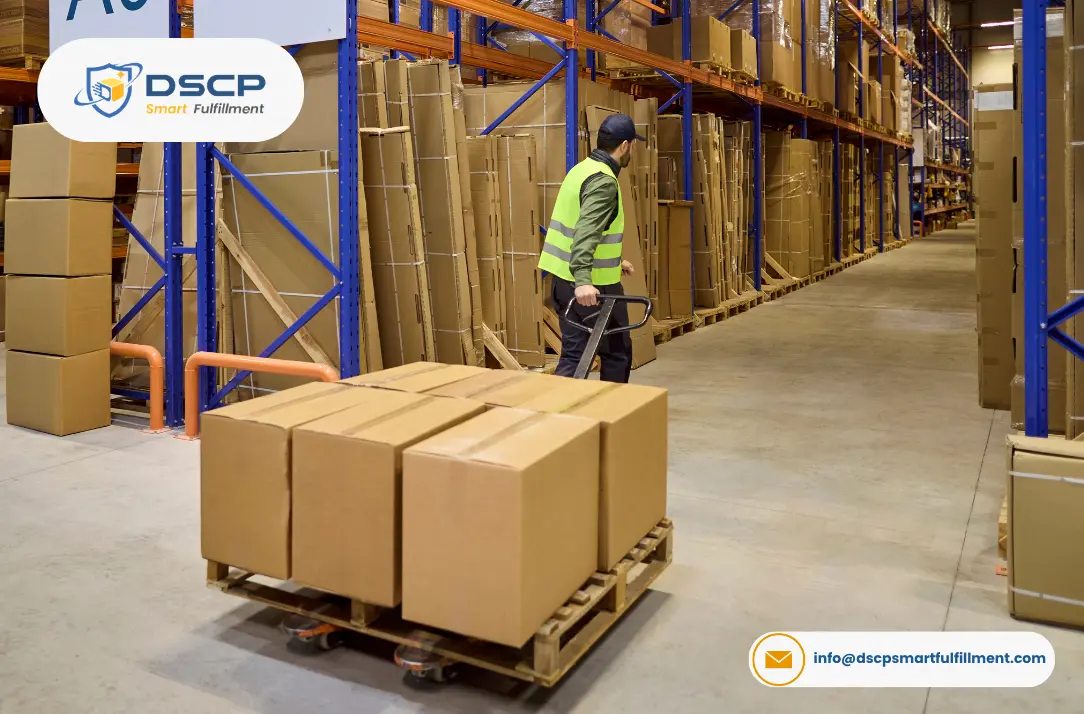
B2B e-commerce dwarfs DTC in raw scale. Online and e-commerce channels now account for 34% of total B2B revenue, and McKinsey data confirms digital channels have overtaken in-person sales as the top-performing B2B revenue channel (Smind, 2026). But the fulfillment operation behind it looks nothing like DTC. B2B orders come with requirements that consumer shipments never involve: specific packaging and labeling standards, palletization rules, routing guides and often EDI (Electronic Data Interchange) compliance that large retailers mandate before they will accept a shipment.
The Key Differences That Actually Matter
While both models involve picking, packing and shipping, the operational realities diverge across six dimensions. Understanding these is what separates a smooth channel expansion from a costly one.
Order Size and Volume
DTC is high order count and low units per order. You might ship 2,000 orders a month, each containing one or two items. B2B is the reverse: low order count, high units per order. A single wholesale purchase order might equal hundreds of individual DTC transactions. As one industry analysis put it, one purchase order from a department store can equal hundreds of individual DTC transactions (NuOrder, 2026). This flips the entire operational rhythm of your warehouse.
Packaging Requirements
DTC packaging is about brand experience: custom boxes, tissue paper, inserts and a memorable unboxing. B2B packaging is about compliance and efficiency: case packs, palletization and standardized labeling that meets the receiving retailer’s exact specifications. A retailer will reject a shipment that does not follow its packaging and labeling rules, so precision matters more than presentation.
Shipping Method
DTC ships via parcel carriers (USPS, UPS, FedEx) in small packages. B2B typically ships via freight (LTL or full truckload) on pallets. The cost structures, transit times and carrier relationships are entirely different, and a fulfillment operation optimized for parcel shipping is not automatically equipped for freight.
Compliance and Documentation
This is where B2B gets genuinely complex. Large retailers impose vendor compliance guidelines covering labeling, palletizing, routing and advance shipping notices. Many require EDI compliance for electronic order and invoice exchange. Failing to meet these requirements results in chargebacks, fees deducted from your payment for non-compliance. DTC has none of this. The customer just wants their order to arrive quickly and correctly.
Delivery Expectations
DTC customers expect speed, often two to four days, with real-time tracking. B2B buyers work on scheduled delivery windows and negotiated timelines, frequently with payment terms like Net 30 or Net 60. The urgency profile is completely different: a consumer wants it now, while a business wants it reliably and on the agreed date.
Cost Structure and Margin
On a per-unit basis, DTC captures the full retail margin but carries high costs: customer acquisition, individual pick-and-pack, parcel shipping and returns, with DTC return rates running 20 to 30% in categories like apparel (Proactive AI, 2026). B2B sells at 40 to 60% below retail price, so margins per unit are lower, but the per-order logistics cost is far cheaper in bulk, and returns are typically negotiated at the account level rather than order by order.
| Dimension | DTC Fulfillment | B2B Fulfillment |
|---|---|---|
| Order Profile | High order count, low units per order | Low order count, high units per order |
| Packaging | Branded boxes, inserts, unboxing experience | Case packs, pallets, compliance labeling |
| Shipping Method | Parcel carriers (USPS, UPS, FedEx) | Freight (LTL or full truckload) |
| Compliance | Minimal; just accurate, fast delivery | EDI, routing guides, vendor compliance rules |
| Delivery Expectation | Fast, 2 to 4 days, real-time tracking | Scheduled windows, negotiated timelines |
| Cost and Margin | Full retail margin, high per-order costs | 40-60% below retail, low per-unit logistics cost |
Running Both: The Hybrid Reality
Increasingly, brands are not choosing between B2B and DTC. They are doing both. The logic is compelling: DTC provides direct customer relationships, first-party data and higher per-unit margins, while wholesale delivers volume, market reach and predictable revenue. Many of the fastest-growing brands in 2026 pursue both channels at once.
But running both is where operations get difficult. Brands that try to bolt a wholesale operation onto a DTC setup often discover the hard way what two disconnected systems cost: duplicated product data, manual inventory reconciliation, inconsistent pricing and inventory contention when a wholesale order and a wave of DTC orders draw from the same stock at the same time. Without clear processes, hybrid fulfillment operations experience delays, errors and margin erosion.
The solution is a unified inventory system. Rather than running two siloed warehouses, the brands succeeding with both channels manage DTC and B2B from a single inventory pool with clear allocation rules. This is the same principle behind a hybrid fulfillment approach: match each order type to the right process while keeping one source of truth for your inventory. A single unified operation prevents the overselling and fulfillment conflicts that break improvised setups.
How to Know Which Model You Need
Most brands do not choose one model in the abstract. They evolve into their fulfillment needs as their business grows. Here is how to think about where you are:
- You need DTC fulfillment if you sell primarily through your own online store and marketplaces, ship individual orders to consumers and compete on delivery speed and brand experience.
- You need B2B fulfillment if you are landing wholesale accounts, selling to retailers or distributors, or shipping bulk orders that require pallets, case packs and compliance with retailer requirements.
- You need both if you run a DTC store and are expanding into wholesale, or you sell wholesale and want to launch a direct channel for higher margins and customer data.
If you are in the third group, the critical decision is not whether to run both, but how to run both without creating two disconnected operations. That is where the choice of fulfillment partner becomes decisive. Not every provider can handle both DTC parcel shipping and B2B freight with retail compliance from a single system.
| Your Situation | Model You Need | What to Prioritize |
|---|---|---|
| Selling through your own store and marketplaces to consumers | DTC | Delivery speed, branding, accurate pick and pack |
| Landing retail, wholesale or distributor accounts | B2B | Freight, palletization, EDI and retail compliance |
| Running DTC and expanding into wholesale (or vice versa) | Both | Unified inventory, one partner handling both channels |
What to Look for in a Partner That Handles Both
If your brand runs or plans to run both channels, evaluate fulfillment partners on their ability to support each without compromise:
- Unified inventory across channels, so DTC and B2B orders draw from one accurate stock pool with clear allocation and no overselling.
- Both parcel and freight capability, since DTC needs fast parcel shipping while B2B needs LTL and full truckload freight.
- Retail compliance experience, including EDI, proper labeling, palletization and routing that keeps you out of chargeback territory.
- Real-time inventory visibility, so you always know what is available to promise to a wholesale buyer versus a consumer.
- Scalability across order types, so a sudden wholesale order does not disrupt your DTC flow or vice versa.
The strongest partners treat fulfillment as a growth function rather than a cost center, helping you expand into new channels rather than just executing shipments. DSCP Smart Fulfillment supports growing brands from US warehouses in Pomona, California, and New Brunswick, New Jersey, with the infrastructure to handle both direct-to-consumer and business orders from a single inventory base. Get in touch to talk through how your channel mix maps to the right fulfillment setup.

Conclusion
B2B and DTC fulfillment are not variations on the same process. They are distinct operational models with different order profiles, packaging, shipping methods, compliance demands, delivery expectations and cost structures. DTC is built for speed, branding and the individual customer experience. B2B is built for bulk, compliance and business relationships.
For a growing brand, the key is recognizing which model your next stage requires, and if the answer is both, building on a unified inventory foundation rather than two disconnected operations. The brands that scale smoothly into new channels are the ones that understand these differences before the first wholesale order lands, and choose a fulfillment setup ready to handle whatever comes next. Know the difference, plan for it and your channel expansion becomes an opportunity rather than an operational scramble.

Subscription Box Fulfillment: Getting the Ship Cycle Right
A late or incomplete box is one of the fastest ways to lose a subscriber. Here is how subscription fulfillment really works, and how to keep every cycle on time.
Shopify Bundles and Kitting: What Sellers Need to Know
Bundles lift average order value, until a missing component breaks a kit. Here's how bundles and kitting really work, and how to keep your inventory accurate.