How Scott & Harry Reached Seven-Figure Months by Choosing Quality Over Short-Term Margins
For most of their early e-commerce career, Scott and Harry optimized for one thing: margin on the first sale. Higher markup meant faster returns on ad spend, quicker profit, and the feeling that things were working. It took a painful series of product failures to show them that this approach was not just limiting their growth. It was actively dismantling it.
The shift that changed everything was deceptively simple. They stopped chasing the highest possible margin on each transaction and started building a business designed to keep customers coming back. That decision, and the fulfillment partnership that made it executable, took them from inconsistent revenue to sustained seven-figure months.
Scott & Harry’s results at a glance:
- 7-figure monthly revenue achieved consistently
- 60% faster issue resolution through direct partner access
- Reduced chargebacks through systematic quality improvements
- Scalable operations built on a real supplier relationship
The Hidden Cost of Prioritizing Margins Over Product Quality
Early in their partnership, Scott and Harry followed a playbook that most e-commerce sellers know well. Find a product with strong markup potential, run ads, collect revenue, repeat. On paper, the margins looked healthy. In practice, the business was leaking value at every stage after the first sale.
The pattern was consistent and damaging:
- Products with the highest initial margins often had the lowest quality. Customers received items that underdelivered on expectations, and the fallout was immediate.
- Return requests climbed. Each return did not just erase the profit from that order. It created additional shipping costs, customer service hours, and inventory complications.
- Chargebacks followed. Dissatisfied customers who could not resolve issues quickly escalated to their payment providers, triggering disputes that carried fees, penalties, and reputational damage with processors.
- Payment processor restrictions compounded the problem. High chargeback rates flagged their accounts, leading to frozen payouts, holds on funds, and, in some cases, temporary shutdowns that halted the entire operation.
Each of these consequences was manageable in isolation. Together, they created a cycle where revenue kept growing on the surface while profitability was being eroded underneath.
It does not matter how much profit you are making if the product quality is poor. You end up with dissatisfied customers, high return rates, chargebacks, and payment processor issues. Then you have no profit at all.
— Scott & Harry, DSCP Smart Fulfillment Clients
The Decision That Changed the Business Mode
Scott and Harry reached a turning point when they recognized that the entire cost structure of a low-quality product extended far beyond the price tag. A cheaper product did not actually produce a cheaper business. It produced an expensive one, just with the costs spread across returns, support, chargebacks, and lost repeat customers instead of concentrated in the cost of goods.
They restructured their approach around three principles:
- Accept higher product costs when the quality justifies it. A slightly more expensive product that customers keep, use, and appreciate generates far more lifetime value than a cheap one that triggers a return or a negative review. The margin on the first order matters less than the total revenue a customer generates over months or years.
- Use the first week of customer feedback as the real quality test. No amount of sample inspection fully predicts how customers will respond at scale. Scott and Harry built a system where the first seven days of customer feedback after a product launch determined whether to continue investing or cut the product entirely.
- Eliminate emotional attachment to products. If a product is not performing against clear metrics, it gets dropped regardless of how much time or money has been invested. This discipline prevents the common trap of running a losing product longer than the data supports, simply because the seller wants to prove their initial judgment was correct.

“We do not get emotionally attached to products. We set clear performance targets before we launch, and we decide based on data and market performance.”
— Scott & Harry, DSCP Smart Fulfillment Clients
Why a Supplier Relationship Required More Than a Screen
Most e-commerce sellers interact with their fulfillment providers entirely through dashboards, emails, and order forms. Scott and Harry did something different. They flew to China. Twice.
The visits fundamentally changed how they understood their own business. Behind every order number on a screen were real facilities, real quality control processes, and real people coordinating production and shipment. Seeing that operation firsthand built a level of trust and mutual understanding that no amount of digital communication could replicate.
That in-person foundation created practical advantages that showed up every day in their operations:
Problems get solved in hours, not days. When an ad account gets restricted or a payment processor freezes payouts unexpectedly, inventory decisions need to happen immediately. Scott and Harry’s direct relationship with DSCP means they can adjust orders, pause shipments, or scale production with a single conversation rather than waiting in a support queue.
Quality feedback reaches the production floor faster. When early customer reviews reveal a product issue, Scott and Harry communicate it directly to DSCP, who coordinates with the factory to implement changes. This feedback loop is measured in days rather than weeks, preventing small quality issues from becoming large-scale problems.
Inventory planning becomes collaborative, not reactive. Daily stock monitoring and open communication about lead times allow Scott and Harry to make confident marketing decisions. They know exactly how many days of inventory remain at current sales velocity and how quickly replenishment can arrive, eliminating the guesswork that causes either stockouts or overexposure.
Meeting our fulfillment partner face to face was the best decision we made. It made us realize that behind the numbers on our screen, there are real operations and real people working to help us grow. That perspective changed how we approach the entire business.
— Scott & Harry, DSCP Smart Fulfillment Clients
The Results: From Inconsistent Revenue to Sustained Growth
The combination of a quality-first product strategy and a relationship-driven fulfillment partnership produced results that neither approach could have delivered alone.
| Metric | Colin’s Results | Typical E-Commerce Benchmark |
|---|---|---|
| Profit margins | 72% average | 20-40% for most online sellers |
| Product return rate | 85% lower than average | 20-30% return rate industry standard |
| Partnership duration | Nearly 4 years | High provider churn in e-commerce |
| Market position | Sustained category leader | Frequent competitor displacement |
- Consistent seven-figure monthly revenue became achievable once the operational foundation supported it. Revenue volatility decreased because product quality reduced the downstream problems, returns, chargebacks, and processor issues that previously created unpredictable cash flow swings.
- 60% faster issue resolution compared to their previous supplier relationships. In e-commerce, the speed at which you can respond to operational disruptions directly affects how much revenue you protect during volatile periods. Hours matter when a payment processor freezes or an ad account gets flagged.
- Reduced chargeback rates protected their payment processing relationships and eliminated the frozen payouts that had previously disrupted their cash flow. Lower chargebacks also improved their standing with processors, reducing the risk of future account restrictions.

How Scott & Harry Approach the Customer Experience
Revenue numbers reflect what happens after a much longer chain of decisions. Scott and Harry treat every interaction point with the customer as an opportunity to build the kind of trust that brings people back.
- Transparent communication about delivery timelines. Rather than overpromising on shipping speed, they set accurate expectations upfront. Customers who know when to expect their order are significantly less likely to contact support or file disputes. Honesty at the point of purchase prevents frustration after it.
- Post-purchase follow-up as a retention tool. Simple check-ins after delivery, asking whether the customer is satisfied, create a sense of care that distinguishes a brand from a faceless transaction. These touchpoints cost almost nothing to implement but have a measurable impact on repeat purchase rates.
- Treating the entire journey as the product. From the advertisement a customer first sees, through the website experience, the checkout process, shipping updates, delivery, and follow-up, Scott and Harry view each stage as part of what the customer is buying. A great product that arrives after a frustrating experience is still a negative experience overall.
The sellers who combine speed, quality, and trust with their customers and supply chain will consistently outperform those focused on short-term gains.
— Scott & Harry, DSCP Smart Fulfillment Clients
Preparing for Peak Season: A Case Study in Operational Discipline
Q4 represents the most concentrated revenue opportunity of the year for e-commerce sellers. It also exposes every weakness in a supply chain. Scott and Harry’s approach to holiday preparation illustrates how their operational discipline translates into real revenue capture.
Their peak season framework includes:
- Daily inventory audits beginning weeks before the demand surge. They calculate remaining stock days at current sales velocity and coordinate replenishment timelines with DSCP to ensure warehouse inventory stays ahead of customer demand.
- Pre-positioned warehouse stock to eliminate production delays. Orders ship immediately from DSCP’s warehouses rather than waiting for factory production, shaving days off delivery times during the period when customers are most impatient.
- Increased creative production for advertising. Q4 represents the highest-intent buying period. Scott and Harry scale their ad output to capture maximum demand while their inventory and fulfillment infrastructure can support the volume.
The result is sustained revenue through the final days of the holiday selling window, while competitors dealing with stockouts, production delays, or shipping cutoffs are forced to stop selling early.
What This Means for Your Business
Scott and Harry’s journey highlights a transition that every scaling e-commerce seller eventually faces. There is a ceiling to what you can achieve by treating the business as a series of individual transactions optimized for first-order profit. Breaking through that ceiling requires infrastructure: reliable product quality, a fulfillment partner you can communicate with in real time, and the operational discipline to make decisions based on data rather than emotion.
DSCP Smart Fulfillment provides the operational backbone that makes this kind of scaling possible. Direct access to dedicated specialists, systematic quality control that adapts to customer feedback, and flexible inventory management that responds to the unpredictable reality of e-commerce growth. The partnership is designed to function as an extension of your business, not as a vendor you submit tickets to.


Shipping From China to an East Coast Warehouse
The route end to end, from a factory in Shanghai to sellable stock in New Jersey. Ocean against air, port choice, customs filings, drayage and receiving.
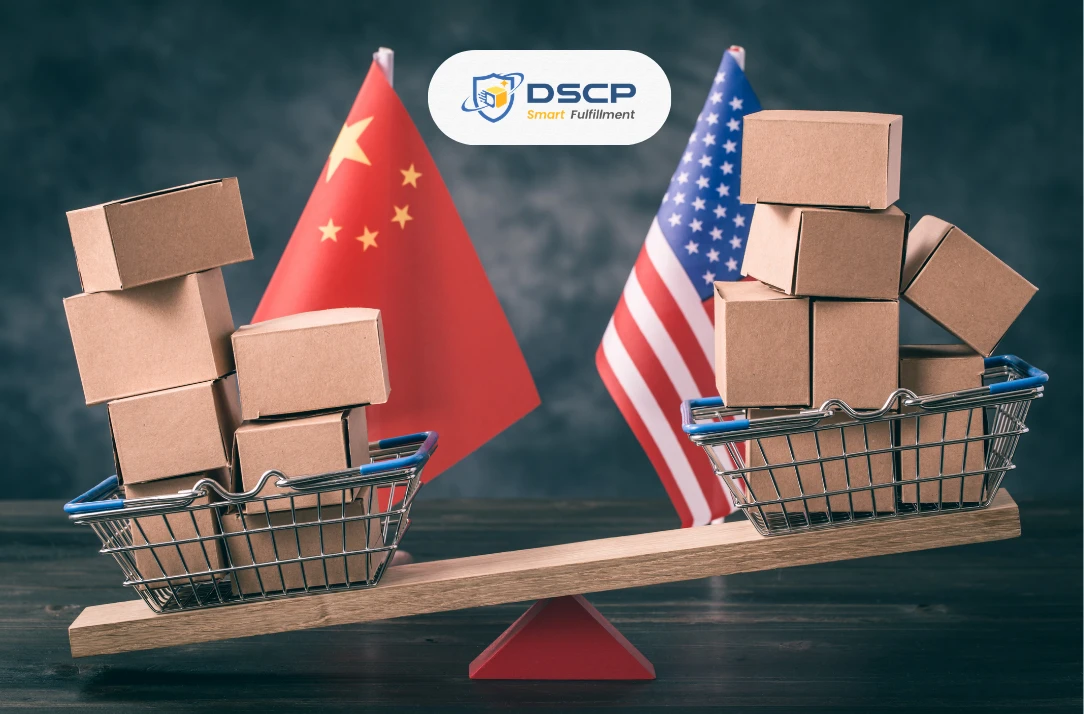
US vs China Fulfillment: Cost, Speed and Capital Compared
Most sellers assume China is cheaper. On our own orders it is not: for light items a US warehouse costs less per order and lands in 2 to 4 days instead of 7 to 12.