
Wholesale Fulfillment: What Growing Brands Need to Know

Wholesale fulfillment is the process of picking, packing, documenting and shipping bulk orders to business buyers instead of individual customers, and it runs on a different set of rules than the direct-to-consumer operation most brands start with. The channel is large and moving fast: US merchant wholesalers recorded $789.1 billion in sales in April 2026 alone, up 13.3% from a year earlier (US Census Bureau, 2026). Buyers are ordering more, they are comfortable placing large orders online, and 71% of B2B companies now run e-commerce, with roughly a third of their revenue flowing through digital channels (McKinsey & Company, 2026).
For Shopify merchants, the barrier to entry just collapsed. On April 2, 2026, Shopify extended native B2B features to Basic, Grow and Advanced plans at no extra cost, putting company profiles, custom catalogs and payment terms in reach without a Plus upgrade (Shopify, 2026). Opening a wholesale channel on the storefront is now a configuration task. Fulfilling those orders is not, and this guide covers what wholesale fulfillment actually involves, how it differs from DTC, where retailer compliance quietly eats margin and what to have in place before your first purchase order arrives.
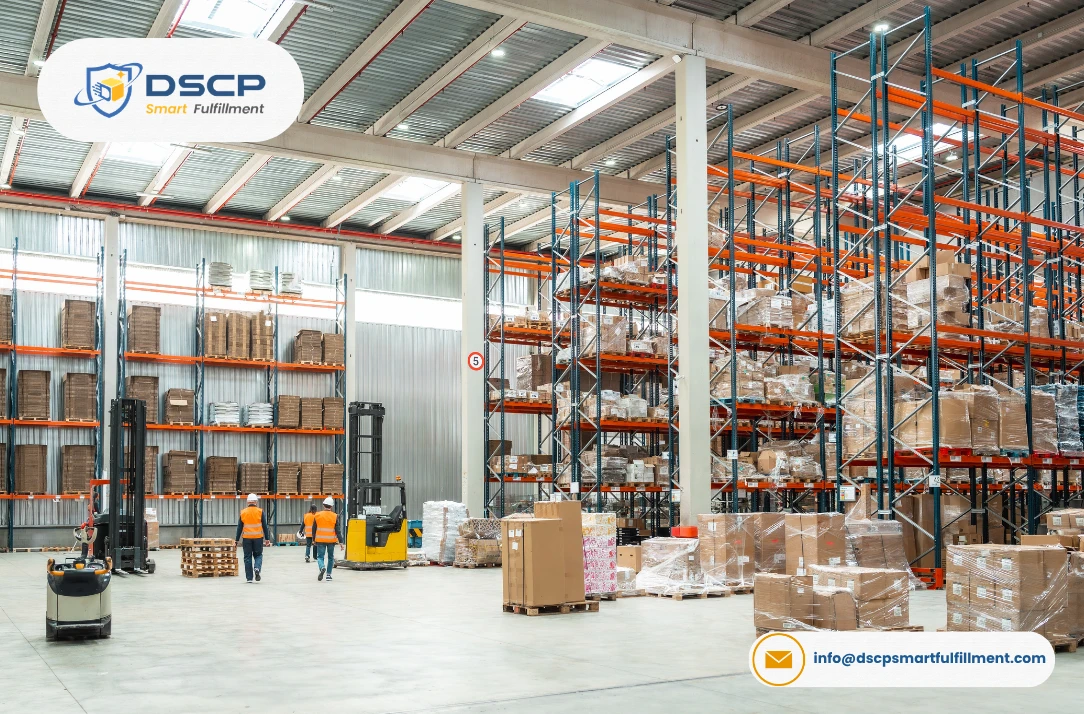
Key Takeaways for Wholesale Fulfillment
- Wholesale fulfillment ships cases and pallets to businesses, with documentation, labeling and delivery-window requirements that DTC parcel fulfillment never imposes.
- Shopify’s April 2026 expansion of native B2B to all paid plans removed the front-end barrier, which means the operational side is now the constraint for most growing brands.
- Retailer compliance is the hidden cost. Missed delivery windows and short shipments trigger chargebacks that come straight out of the invoice.
- One inventory pool across DTC and wholesale is the single most important structural decision, because split stock causes overselling on one channel and dead inventory on the other.
- DSCP Smart Fulfillment holds master inventory across bi-coastal US warehouses and fulfills DTC and bulk orders from the same pool, with transparent pricing and a dedicated account manager.
What Is Wholesale Fulfillment?
Wholesale fulfillment is the end-to-end process of receiving, storing, picking, packing and shipping large-quantity orders to business buyers such as retailers, distributors, resellers and corporate accounts, rather than to individual consumers. Orders are placed against a purchase order at negotiated pricing, picked at case or pallet level instead of unit level, packed to the buyer’s specifications, accompanied by business documentation such as packing lists and advance ship notices, and moved by freight rather than parcel carriers. The defining characteristic is not the size of the warehouse but the identity of the buyer and the compliance rules that buyer attaches to the delivery.
That last point is what catches brands out. A wholesale order is not simply a large DTC order. It carries a delivery window, a labeling standard, a documentation requirement and a financial penalty for getting any of them wrong.

Why Wholesale Is on Every Growing Brand’s Roadmap
Three forces are pushing DTC-first brands into wholesale at the same time.
Acquisition costs have made single-channel growth expensive, and a wholesale account delivers volume without paying for every order individually. A single retail partner placing quarterly replenishment orders can represent revenue that would take thousands of paid-acquisition conversions to match.
Buyer behavior has shifted toward self-service. McKinsey’s research found buyers now use an average of ten channels across the purchasing journey and expect to move between them without friction, with inconsistent information across teams cited as the top reason for switching suppliers (McKinsey & Company, 2026). Wholesale buyers increasingly want to log in, see their pricing and reorder, rather than email a sales rep.
And the tooling caught up. Shopify’s B2B release put company profiles, up to three custom catalogs, volume pricing, quantity rules and net payment terms on every paid plan, with unlimited catalogs, direct catalog assignment and partial payments remaining exclusive to Plus (Shopify, 2026). Wholesale and DTC now run from one admin, one product catalog and one inventory record.
The storefront is solved. The warehouse is where the work moved.
How Wholesale Fulfillment Differs From DTC
The two models share a building and very little else. The differences compound:
| Dimension | DTC Fulfillment | Wholesale Fulfillment |
|---|---|---|
| Buyer | Individual consumer | Retailer, distributor or reseller |
| Order profile | High frequency, low volume | Low frequency, high volume |
| Pick unit | Individual eaches | Cases, inner packs and pallets |
| Documentation | Shipping label | PO reference, packing list, BOL, ASN |
| Transport | Parcel carrier | LTL or full truckload freight |
| Cost of an error | Replacement unit and goodwill | Chargeback on a percentage of the invoice |
That final line is the one most brands underestimate. Our comparison of B2B and DTC fulfillment goes deeper into how the two models diverge across cost structure, staffing and cash flow.
The Operational Bar for Wholesale Fulfillment
Before evaluating any partner, it helps to be precise about what wholesale capability requires. Five things matter:
- Case and pallet handling: The ability to receive bulk inventory, pick at case level, build stable and correctly configured pallets, and stage them for freight pickup. This is a different physical process than picking individual units, with different equipment and different labor.
- Labeling and documentation: Carton labels, pallet labels, purchase order references, packing lists and bills of lading, produced to each buyer’s specification rather than a generic template.
- Unified inventory across channels: One accurate stock picture covering DTC, wholesale and any marketplace inventory. Without it, a large wholesale allocation silently strands your DTC availability, or the reverse.
- Freight capability: Wholesale ships palletized freight, not parcel. A partner that subcontracts every pallet adds a handoff, and every handoff is a place a delivery window can slip.
- Appointment and window discipline: Larger buyers schedule receiving appointments and enforce them tightly. Arriving early can be as much of a failure as arriving late.
A provider missing any one of these pushes that work back onto your team, which defeats the reason for outsourcing in the first place. The mechanics behind accurate order assembly are covered in our breakdown of pick and pack fulfillment.
| Capability | What It Means | What Breaks Without It |
|---|---|---|
| Case and pallet handling | Case-level picking and correctly configured pallet building | Rejected or mis-received shipments at the dock |
| Labeling and documentation | Carton labels, PO references, packing lists and BOLs to spec | Compliance chargebacks on otherwise good orders |
| Unified inventory | One accurate stock picture across DTC and wholesale | Overselling one channel, dead stock on another |
| Freight capability | Palletized LTL and truckload handled natively | Extra handoffs where delivery windows slip |
| Window discipline | Hitting scheduled receiving appointments, not early or late | On-time failures even when the product is correct |
Retailer Compliance and the Chargeback Problem
If you sell into chain retail, compliance is not a formality. It is a line item.
How chargebacks work
Major retailers score suppliers on whether shipments arrive on time and complete, and they deduct penalties directly from supplier invoices when performance falls short. Walmart’s On-Time In-Full program is the most visible example. From September 2020, the requirement sat at 98%, and on February 1, 2024, Walmart lowered the targets to 90% for on-time and 95% for in-full (Forbes, 2024). Target, Kroger, Costco and most large chains run their own versions under different names, each with its own routing guide and penalty schedule. The rules are not interchangeable, and a single shipment can fail more than one program at once.
Why it matters more than the headline rate
Lower thresholds did not make the problem go away. Forbes reported that delivery compliance failures have been estimated to cost the consumer goods industry more than a billion dollars a year, with fines for many suppliers running past $1 million annually (Forbes, 2024).
Three things make these penalties dangerous for a growing brand: they are deducted rather than invoiced, so they surface as a shortfall in a payment you already counted on; they are a percentage of goods rather than a flat fee, so they scale with your success; and they are far easier to prevent than to dispute. That is why “we can handle bulk orders” is not a sufficient answer from a prospective partner. Bulk handling and retail compliance are two different competencies.
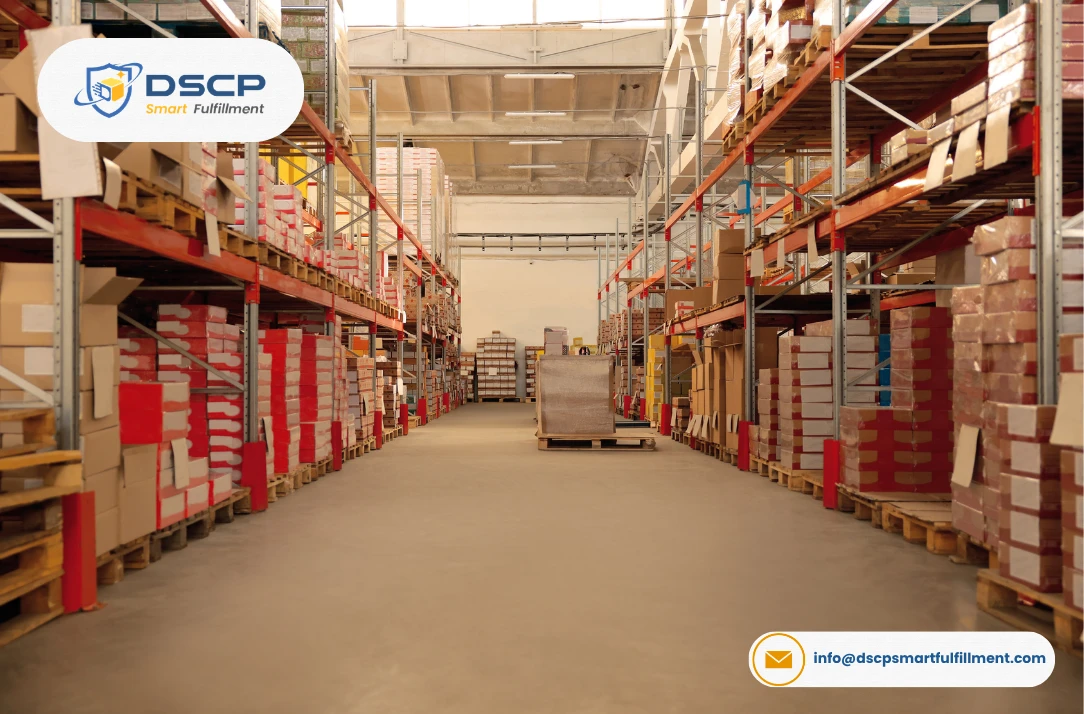
How to Add Wholesale Without Breaking DTC
Adding a second channel to an operation built for one is where most of the failures happen. A workable sequence:
- Decide what you are actually selling: Wholesale to independent boutiques, wholesale to a distributor and vendor supply to a national chain are three different operations with three different compliance burdens. Pick one to start.
- Set the commercial rules before the operational ones: Pricing tiers, minimum order quantities, case-pack sizes and payment terms all shape how the warehouse has to pick. Shopify’s native B2B tools handle catalogs, volume pricing, quantity rules and net terms without additional apps on any paid plan.
- Keep one inventory pool: Resist the instinct to physically separate wholesale stock. One pool with allocation logic gives you the flexibility to move units to whichever channel is selling, which is the entire financial argument for running both.
- Pilot with a single account: Run one buyer end to end, including the documentation and the freight, before you sign three more. The failure modes surface fast and cheaply.
- Measure the right things: On-time delivery rate, fill rate and chargeback dollars per account tell you whether the channel is profitable. Revenue alone will not.
Brands running DTC alongside marketplace inventory face a related version of the same allocation problem, covered in our guide to hybrid fulfillment, and the broader evaluation criteria are laid out in our walkthrough on how to choose a 3PL provider.
Where DSCP Smart Fulfillment Fits
DSCP Smart Fulfillment is built to serve as the fulfillment backbone for brands running direct-to-consumer and wholesale from one inventory pool. Orders placed by 5 PM EST ship the same day at 99.9% pick and pack accuracy, which is the discipline that keeps a short shipment from becoming a compliance failure. Inventory sits in two US warehouses, in Pomona, California, and New Brunswick, New Jersey, reaching roughly 80% of the US population within two to four days by ground. That bi-coastal position matters more for wholesale than DTC, because it shortens the inbound lane to a buyer’s distribution center and gives you two origin points when a delivery window is tight.
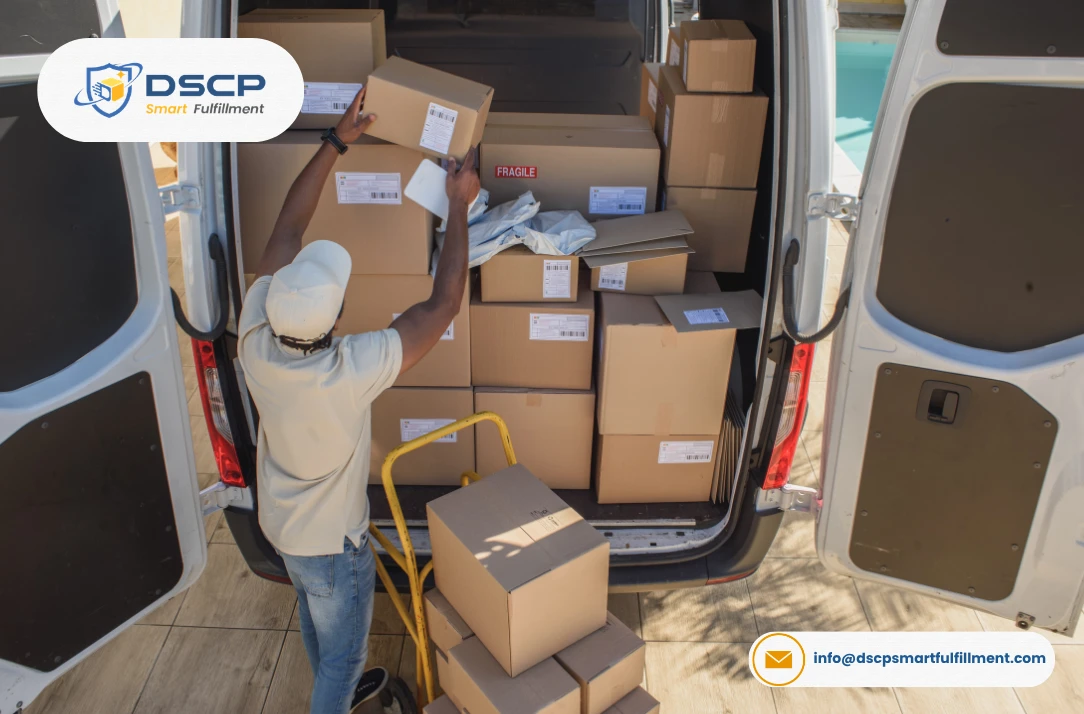
The Shopify connection is native, with a REST API for custom-coded stores, so DTC and B2B orders both route automatically and inventory syncs in real time across every channel. What clients highlight is the part that is hardest to find: pricing that is both genuinely competitive and fully transparent with no hidden fees, and support that is easy to reach through a dedicated account manager who knows your business.
DSCP Smart Fulfillment serves more than 2,500 e-commerce brands, holds a 4.8 out of 5 Trustpilot rating and brings over ten years of operational experience to both sides of the operation. The same operation sits behind our e-commerce fulfillment and 3PL warehousing services, with the platform side handled through Shopify fulfillment.
What to Verify Before You Commit
Wholesale has more failure points than DTC, so pin these down with any provider before signing:
- Confirm case and pallet capability in detail: Ask specifically about case-pack configurations, pallet building standards and how they handle a buyer-specified carton spec.
- Test inventory sync across channels: Confirm that DTC and wholesale draw from one accurate pool, with visibility into what is allocated where.
- Ask about the documentation you will actually need: Packing lists, bills of lading, purchase order references and, if you sell into chain retail, electronic advance ship notices. Get a straight answer on which of these they produce.
- Check freight handling: Confirm whether palletized outbound freight is handled natively or subcontracted, and who owns the delivery appointment.
- Request current accuracy and on-time figures: Ask for the last 90 days. Strong providers share them without hesitation.
- Agree on how errors are handled: Find out who absorbs the cost when a shipment goes out short, and get it in writing before your first purchase order, not after your first chargeback.
Build Your Wholesale Channel on an Operation That Can Carry It
If you are adding wholesale alongside a growing DTC business, DSCP Smart Fulfillment holds your master inventory and fulfills both channels from the same pool. Same-day shipping for orders placed by 5 PM EST, 99.9% pick and pack accuracy, two-to-four-day delivery to 80% of the US from California and New Jersey warehouses, native Shopify integration with a REST API for custom stores, competitive and transparent pricing, and a dedicated account manager who knows your accounts. Get in touch to map out your wholesale setup.

Conclusion
Wholesale is no longer a separate business that requires a separate platform. Shopify put the commercial tooling on every paid plan, buyers are comfortable placing large orders digitally, and the wholesale channel itself is growing at double digits. What has not changed is that the operation behind it is genuinely different from DTC, and the gap shows up in cases, pallets, documents, delivery windows and the penalties attached to missing them.
The brands that make wholesale profitable are the ones that treat it as an operational commitment rather than a pricing decision. Set the commercial rules first, keep one inventory pool, pilot with a single account, measure fill rate and chargebacks rather than revenue alone, and choose a fulfillment partner whose accuracy and responsiveness you would be comfortable putting in front of a buyer who deducts money when you miss.

Subscription Box Fulfillment: Getting the Ship Cycle Right
A late or incomplete box is one of the fastest ways to lose a subscriber. Here is how subscription fulfillment really works, and how to keep every cycle on time.

Shopify Bundles and Kitting: What Sellers Need to Know
Bundles lift average order value, until a missing component breaks a kit. Here's how bundles and kitting really work, and how to keep your inventory accurate.