
What Is an HTS Code? How to Find Yours (2026 Guide)
An HTS code is the 10-digit number that classifies every product imported into the United States and sets the duty you pay on it. The first six digits are the international Harmonized System code, and the last four are US-specific. The schedule is far from static: the US International Trade Commission had already published Revision 23 of the 2026 Harmonized Tariff Schedule by mid-November (US International Trade Commission, 2026).
Getting the code right matters more than most brands expect. For beauty products, the official schedule lists lip, eye and nail make-up, powders and most skin care at a Free general duty rate, while deodorants, bath salts and shaving products carry 4.9% to 5.8%. This guide shows how the code is built, how to find yours on the official USITC tool, how to classify gift sets and what a wrong code costs.
Key Takeaways for HTS Codes
- An HTS code has 10 digits: a 6-digit international HS code, a 2-digit US tariff line that sets the duty rate and a 2-digit statistical suffix.
- The official, free source is the USITC HTS search at hts.usitc.gov. It changes often, with 23 revisions of the 2026 schedule published by mid-November.
- Most make-up and skin care under heading 3304 has a Free general duty rate, while deodorants, bath salts and shaving products carry 4.9% to 5.8%.
- Extra tariffs listed in Chapter 99 can apply on top of the general rate depending on where a product is made.
- Gift sets are classified by the item that gives the set its essential character, so a set built around a serum is usually classified as skin care.
What Is an HTS Code?
An HTS code, short for Harmonized Tariff Schedule code, is the number US Customs and Border Protection uses to identify an imported product, decide its duty rate and record trade statistics. The schedule is published and maintained by the US International Trade Commission. Each code describes a product by what it is, what it is made of and how it is used, narrowing from a broad chapter down to a precise 10-digit line. Importers declare the code on every customs entry, and the importer of record is responsible for its accuracy.
Anatomy of an HTS Code
Every 10-digit HTS code reads from broad to specific. Here is how a face serum, classified as 3304.99.50.00, breaks down.
HTS Code Decoder: Check Any Code
Paste any HTS code, with or without dots, to see what each part means. For beauty products in Chapter 33, the decoder shows the general duty rate from the current schedule. For every code, it links straight to the live official entry on USITC, so you always confirm the rate against the source.
HS Code vs HTS Code vs Schedule B
Three numbers get mixed up all the time. They share the same 6-digit base, but each serves a different purpose, and using the wrong one on a US import entry is a common early mistake.
| HS Code | HTS Code | Schedule B | |
|---|---|---|---|
| Digits | 6 | 10 | 10 |
| Used for | Classifying goods in trade between most countries | Importing goods into the United States | Exporting goods from the United States |
| Maintained by | World Customs Organization | US International Trade Commission | US Census Bureau |
| Sets US import duty | No | Yes, at the 8-digit level | No |
| Beauty example | 3304.99 | 3304.99.50.00 | Schedule B number for the same serum, used only on exports |
In practice, your overseas supplier will often quote a 6-digit HS code. That is a good starting point, but a US entry needs the full 10-digit HTS code, and the last four digits are where the US duty rate is set.
How to Find Your HTS Code on USITC, Step by Step
The official tool at hts.usitc.gov is free and always shows the current revision. Here is how to use it well, with a lip product as the example.
- Describe the product precisely. Write down what it is, what it is made of and how it is used, the same way a customs officer would read it.
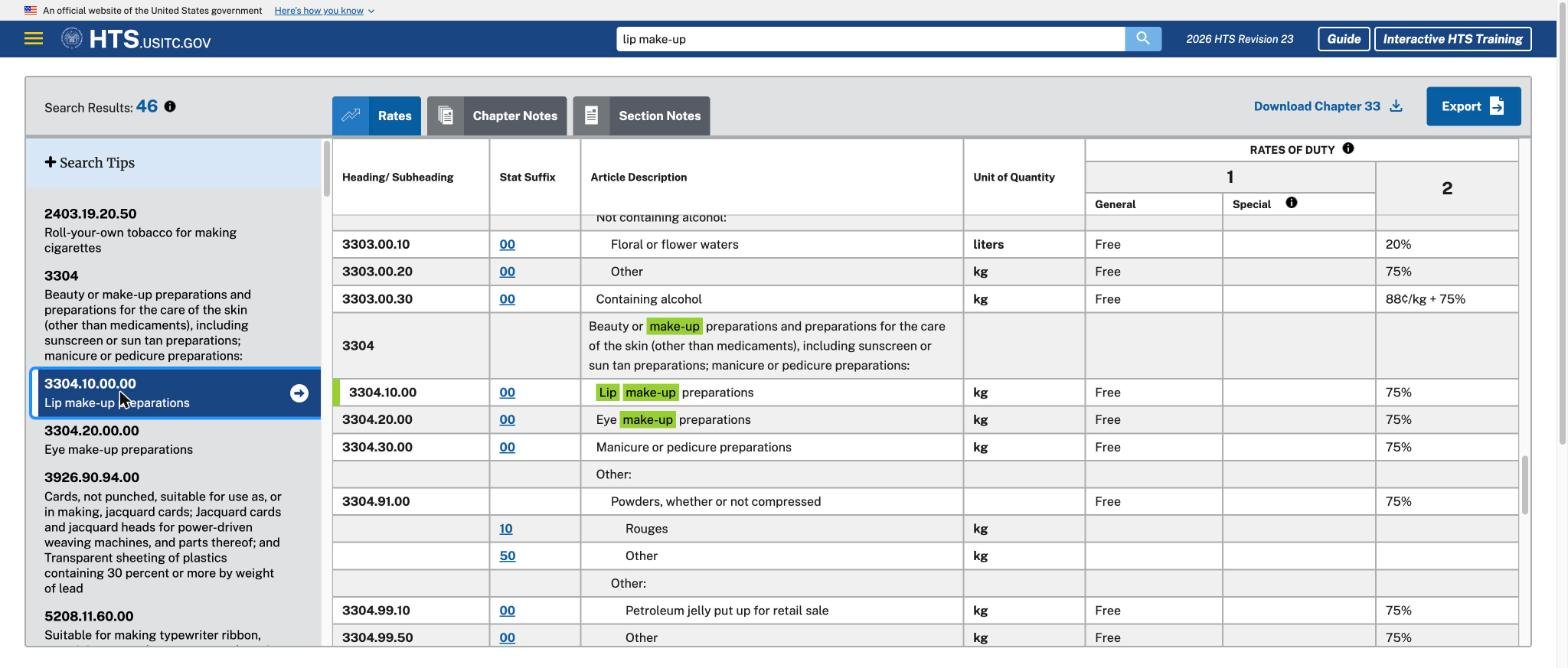
- Search, then ignore the noise. A keyword search for “lip make-up” returns 46 results, and the first is roll-your-own tobacco. Scan the results list for the heading that actually describes your product, here 3304.10.00.00, Lip make-up preparations.
- Read the rates table. Click the result to see the full heading with every sub-line, the General, Special and Column 2 duty rates and the unit of quantity.
- Check the chapter notes. The Chapter Notes tab holds the legal text that decides what belongs in a chapter, and it overrides keyword intuition.
- Check the footnotes and Chapter 99. Footnotes on a rate line point to extra duties that can apply based on the country of origin.
- Record your reasoning. Keep a short note of why you chose the code. If CBP ever questions it, that record shows you used reasonable care.
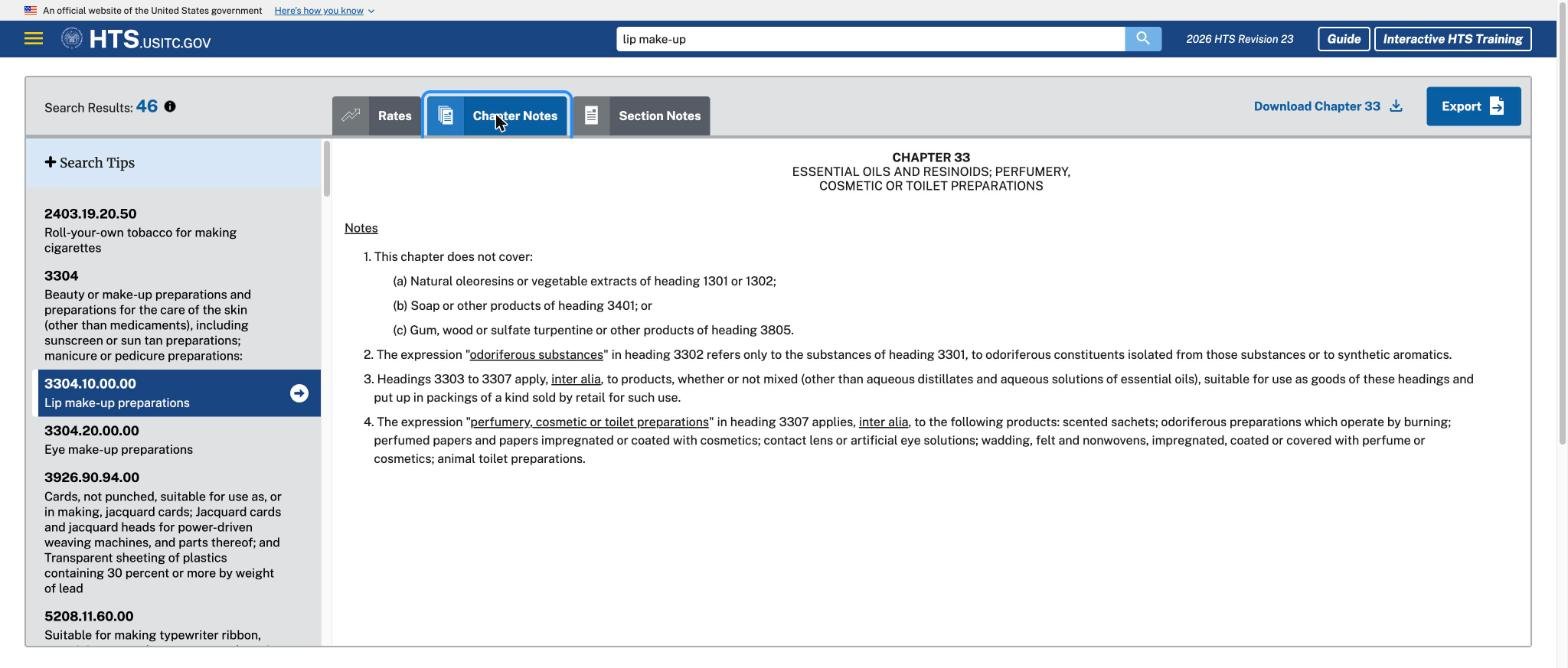
That soap note catches many beauty brands. A cleansing bar is not classified with skin care under heading 3304, but under heading 3401 in Chapter 34, with its own rates. Notes like this are why the chapter text matters as much as the keyword search.
HTS Codes for Beauty Products
Most beauty products sit in Chapter 33, and the general duty picture is better than many founders expect. Make-up and skin care under heading 3304 enter at a Free general rate, as do perfumes and most hair products. Deodorants, bath preparations and shaving products are the exceptions.
A Free general rate does not always mean a duty-free shipment. Additional duties listed in Chapter 99 can apply depending on where a product is made, and those change with trade policy. That is why our landed cost calculator asks for your total duty rate, the general rate plus any extra tariffs for your origin, rather than assuming zero.
How to Classify Beauty Gift Sets
Holiday sets and kits are where classification gets tricky, because one box can hold products from different headings. The General Rules of Interpretation that open the HTS settle it. Under Rule 3(b), goods put up in sets for retail sale are classified as if they consisted of the item that gives the set its essential character. When no single item clearly does, Rule 3(c) sends the set to the heading that comes last in numerical order among those that could apply.
- A serum, a cream and a cosmetic bag: the skin care gives the set its character, so it is usually classified under heading 3304.
- A perfume with a matching body lotion: the fragrance usually drives the value and the purpose, pointing to heading 3303.
- A set with no clear lead item: Rule 3(c) applies, and a binding ruling from CBP is worth requesting before a large shipment.
If you assemble sets in the US instead, the parts arrive under their own codes and become a set after import, which is one reason many brands kit gift sets at their fulfillment center. Our kitting and assembly service builds retail-ready beauty sets from components held in our warehouses.

How Often HTS Codes Change
HTS codes are not fixed. The USITC publishes a new edition each year and revises it throughout the year as trade actions, agreements and statistical needs change. The 2026 schedule had already reached Revision 23 by mid-November (US International Trade Commission, 2026). Most beauty codes stay stable from year to year, but the rates and the extra tariffs attached to them can move, which is why copying a code from an old invoice or a supplier’s paperwork is risky. Check the current revision before every new product launch and at least once a year for existing products.
What Happens If You Use the Wrong HTS Code
Classification is the importer of record’s legal responsibility, and US law expects importers to use reasonable care. A wrong code can lead to:
- Extra duty and interest if the correct code carries a higher rate than the one you declared.
- Penalties under 19 U.S.C. 1592, which rise with the level of fault, from negligence to fraud.
- Holds and delays while CBP questions an entry, plus the storage charges that build up at the port.
- Overpaying when you choose a dutiable code for a product that qualifies for a Free line.
For products that are genuinely hard to classify, you can ask CBP for a binding ruling before you import. The ruling fixes the classification for that product, and past rulings are searchable online, which helps when a similar product has already been decided. A licensed customs broker can prepare the request.
From HTS Code to Landed Cost
Your HTS code is the first input in your import costs. It sets the duty rate, which feeds into what each unit costs to land in the US alongside freight, CBP fees and broker charges. Once you have the code, run your numbers through our landed cost calculator, make sure your customs bond covers the duties you expect to pay, and for beauty products, follow the full route in our guide to importing cosmetics to the USA. Who pays that duty depends on your delivery terms, which our DDP vs DAP guide explains.
How DSCP Smart Fulfillment Helps Beauty Brands Import
DSCP Smart Fulfillment plans the import side with international brands before the first shipment, working alongside licensed customs brokers who confirm classifications and file entries. Duties, clearance and bond costs are set out line by line in your quote, so there are no surprises at the port. Once released, stock arrives at our New Jersey 3PL warehouse in New Brunswick or our West Coast fulfillment center in Chino, California, ships with same-day dispatch for orders placed by 5 PM EST and reaches US customers in 2 to 4 days. Beauty brands can see how this works on our cosmetics fulfillment page.

Plan Your First US Import With the Right Code
Getting the HTS code right is the first step toward predictable landed costs. DSCP Smart Fulfillment can map the classification, clearance and delivery into our warehouses with you, with every cost in writing and a dedicated account manager from day one. Get in touch to plan your next shipment.
Conclusion
An HTS code is a 10-digit classification that decides what you pay when goods enter the US. The first six digits are shared worldwide, the next two set the US duty rate and the last two serve trade statistics. Find yours on the free USITC tool, read the chapter notes and footnotes, record your reasoning and recheck it whenever a new revision lands, which in 2026 has meant more than twenty times. For beauty brands, most make-up and skin care carries a Free general rate, but deodorants, bath and shaving products do not, gift sets follow the essential character rule and soap belongs in a different chapter altogether.

DDP vs DAP: Who Pays US Import Duty and Which to Choose
DDP vs DAP explained for brands importing into a US warehouse: who pays duty, who acts as importer of record, a worked cost example and which to choose.

Customs Bond Guide: Types, Costs and How to Get One
Continuous or single transaction? How CBP sizes customs bonds, why cosmetics need three times the value, what a bond costs and how to get one in time.